 Menos casos Mejores resultados (Es)





¿Aumentaron los accidentes de bicicleta en Portland en 2025?

Portland se ha ganado su reputación como una ciudad amigable para las bicicletas, pero la imagen de seguridad ha cambiado rápidamente en los últimos años. Más personas están volviendo a andar en bicicleta, las velocidades en las arterias principales siguen siendo un problema y las consecuencias de un solo error pueden ser graves cuando un ciclista se encuentra con un vehículo en movimiento. En 2025, los habitantes de Portland sintieron esa tensión en tiempo real. Más situaciones de peligro, más escenas de ambulancias y más ciclistas haciendo la misma pregunta: ¿está empeorando?.
Aquí viene la parte difícil. Los recuentos más completos de accidentes y lesiones no se publican de inmediato. En Oregón, los informes oficiales de accidentes suelen llegar mucho después de que termina el año, lo que significa que se necesita tiempo para confirmar un recuento completo de los accidentes de bicicleta de 2025. Aún así, la tendencia que lleva a 2025 es clara y preocupante. Los accidentes con lesiones de ciclistas aumentaron drásticamente después de 2020, y el seguimiento preliminar de las muertes continúa mostrando que las personas en bicicleta siguen siendo algunos de los usuarios de la vía pública más vulnerables en las calles de Portland. Ya sea que lo llames un accidente en bicicleta o un percance ciclista, la realidad es la misma. Cuando ocurre un accidente, el cuerpo humano pierde esa batalla cada vez.
Por qué las cifras de Portland para 2025 destacan, incluso antes de que lleguen los totales finales de accidentes
Cuando los clientes y las familias hablan de que el 2025 será el año más difícil, generalmente están reaccionando a una de dos cosas.
- Choques y cuasi-accidentes más frecuentes en los mismos corredores que la gente usa todos los días.
- Resultados más graves cuando ocurren accidentes, incluidas lesiones que cambian la vida.
Ese segundo punto es importante. El trabajo de Visión Cero de Portland separa “todos los accidentes” de los accidentes que causan el mayor daño. Esos son los accidentes mortales y los que causan lesiones graves en todos los modos de transporte. La ciudad también analiza otros accidentes en los que se ven involucrados peatones y ciclistas, incluso cuando las lesiones se califican como leves, porque hace falta muy poco para que un incidente menor se vuelva catastrófico cuando aumentan las velocidades o disminuye la visibilidad.
Es por eso que 2025 puede parecer el peor año incluso antes de que se publiquen los totales finales a nivel estatal. Cuando las lesiones graves se mantienen elevadas año tras año, un pequeño aumento en la exposición puede traducirse en más accidentes. Más gente usando bicicletas, más entregas, más bicicletas eléctricas, más desplazamientos y más interacciones con conductores distraídos en corredores de alta velocidad pueden sumar rápidamente.
Una instantánea de 2020 a 2025 que puedes entender de un vistazo
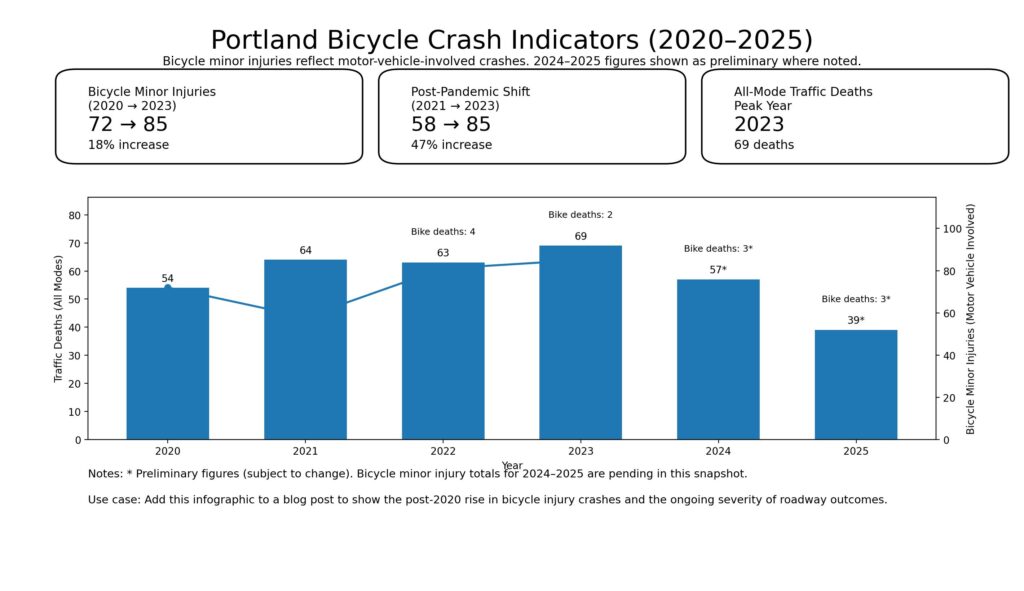
Una de las señales de tendencias más claras utilizadas en los informes urbanos es el número de ciclistas que sufrieron lesiones leves en choques con vehículos motorizados. No es lo mismo que “todos los choques de bicicletas”, pero es un indicador constante que ayuda a mostrar si los choques con lesiones están aumentando o disminuyendo con el tiempo.
| Año | Personas en bicicleta con lesiones leves (involucradas en accidente vehicular) | Muertes por tránsito, todos los modos (preliminar donde se indica) | Personas en bicicleta fallecidas (preliminar donde se indica) |
|---|---|---|---|
| 2020 | 72 | 54 | No aparece en el mismo formato |
| 2021 | 58 | 64 | No aparece en el mismo formato |
| 2022 | 81 | 63 | 4 |
| 2023 | 85 | 69 | 2 |
| 2024 | Totales oficiales de heridos pendientes | 57 (preliminar) | 3 (preliminar) |
| 2025 | Totales oficiales de heridos pendientes | 39 (preliminar) | 3 (preliminar) |
Lo que esto muestra es un fuerte repunte en los accidentes con ciclistas lesionados después de 2021, con cifras en aumento hasta 2022 y 2023. Esa es la trayectoria hasta 2025. Incluso sin el recuento finalizado de lesiones de 2025, la tendencia post-2020 explica por qué tantos ciclistas experimentaron 2025 como un año de quiebre.
Qué cuenta como un accidente de bicicleta en la vida real
La mayoría de la gente dice “Accidente de bicicleta” como una abreviatura, pero los accidentes de bicicleta siguen algunos patrones comunes, y esos patrones son importantes cuando intentas determinar la culpa, el seguro y qué pruebas conservar.
- Cambios de dirección en intersecciones, incluyendo virajes cerrados a la derecha y virajes a la izquierda cruzando la trayectoria de un ciclista
- Choques por apertura de puertas, donde el conductor o pasajero abre una puerta en la trayectoria de un ciclista
- Apartaderos en accesos vehiculares donde un vehículo se incorpora a la vía sin ceder el paso
- Rebase inseguro, especialmente en carriles angostos o donde desaparecen los carriles para bicicletas.
- Choques por alcance cuando el tráfico se detiene repentinamente y un conductor está distraído
Un accidente de bicicleta rara vez es “solo mala suerte”. La mayoría son resultados predecibles de la velocidad, la visibilidad y las decisiones tomadas en los segundos previos al impacto.
¿Qué está causando más accidentes en Portland?
La mayoría de los accidentes de bicicleta no son aleatorios. Ocurren por razones que se repiten: velocidad, conflictos al girar, problemas de visibilidad, distracciones y diseños de calles que crean demasiadas oportunidades de confusión.
Velocidades más altas reducen el tiempo de reacción
La velocidad es un multiplicador. Reduce la capacidad de un conductor para detectar y responder a una persona en bicicleta y aumenta la fuerza entregada en una colisión. Un accidente que podría haber sido un golpe en la cadera a 30 km/h puede convertirse en una lesión cerebral traumática o múltiples fracturas a velocidades más altas. En un accidente de bicicleta, el margen de error del ciclista ya es mínimo. Una mayor velocidad hace que ese margen desaparezca.
Ganchos de derecha y giros de izquierda sobre la trayectoria de un conductor
Muchos accidentes graves de bicicleta ocurren en intersecciones o entradas de autos donde un conductor gira hacia la trayectoria del ciclista. Algunos conductores buscan autos y no ven bicicletas. Otros subestiman la rapidez con la que se acerca una bicicleta. El resultado es un impacto lateral, una parada repentina y un ciclista arrojado a la vía. Si alguna vez ha sido atropellado o casi atropellado en un escenario de "gancho derecho", sabe lo rápido que un paseo rutinario puede convertirse en un accidente de bicicleta que lo cambia todo.
Conducir de Noche, Lluvia y Deslumbramiento
La larga y oscura temporada de Portland aumenta el riesgo. El deslumbramiento de los faros, el pavimento mojado y el anochecer temprano dificultan la apreciación de la distancia. Un ciclista puede usar luces y equipo reflectante y aun así ser difícil de ver si un conductor va demasiado rápido para las condiciones o mira su teléfono en lugar del camino. Estas condiciones también dificultan la documentación de la escena posteriormente, por lo que las fotografías y los nombres de los testigos son tan importantes.
Vehículos más grandes y conducción distraída
Portland no es inmune a la tendencia nacional hacia vehículos más grandes. Capotas más altas y pesos en vacío mayores dejan menos margen de error, especialmente en situaciones de giro. Si se añade la distracción, la explicación de “no los vi” se vuelve más común de lo que debería ser. Muchos casos de accidentes de bicicleta involucran una combinación de falta de atención, velocidad y un conductor que asumió que el carril estaba libre sin confirmarlo realmente.

Dónde suelen ocurrir la mayoría de los accidentes de bicicleta en Portland, Oregón
Los accidentes se concentran en un número relativamente pequeño de calles e intersecciones. Es por eso que Portland utiliza un enfoque de Red de Alto Índice de Accidentes. Concentra la atención en los corredores donde las mejoras de diseño, el control de velocidad y los cambios específicos de seguridad pueden tener el mayor impacto.
Si tu ruta incluye habitualmente calles amplias de varios carriles, accesos frecuentes o bajadas pronunciadas hacia intersecciones, estás circulando en entornos con una mayor probabilidad de sufrir consecuencias graves cuando algo sale mal. Desde un punto de vista legal, estas ubicaciones también pueden ser importantes porque ayudan a explicar por qué una colisión era previsible y por qué el deber de un conductor de reducir la velocidad y ceder el paso no es opcional.
Las lesiones más comunes en accidentes de bicicleta
Los choques de bicicleta a menudo parecen serios después de una colisión en bicicleta, pero pueden ser mortales en la vida real. Las lesiones comunes que vemos después de colisiones de bicicletas incluyen:
- Conmociones cerebrales y lesiones cerebrales traumáticas
- Fracturas faciales y trauma dental
- Fracturas de clavícula, muñeca, brazo y costillas
- Fracturas de cadera, rodilla y tobillo
- Sarpullido en la piel que se infecta o requiere injerto de piel
- Lesiones de la médula espinal y daño nervioso
Incluso las lesiones que se catalogan como “leves” pueden interrumpir meses de trabajo y vida familiar. Y cuando las lesiones involucran la cabeza, la columna vertebral o fracturas complejas, los costos a largo plazo suelen ser mucho más altos de lo que la gente espera en la primera semana después de un accidente. Un accidente de bicicleta también puede generar pérdidas secundarias, como una bicicleta destruida, equipo dañado y la necesidad de apoyo de transporte mientras te recuperas.
Qué hacer después de un accidente de bicicleta en Oregón o en cualquier otro lugar
Si te lesionas, tu primera prioridad es tu salud. Tu segunda prioridad es preservar los hechos mientras aún estén disponibles. Los pasos a continuación te ayudarán a proteger ambas cosas.
- Busca atención médica el mismo día cuando sea posible. Los síntomas a menudo empeoran más tarde.
- Llama al 911 y solicita una respuesta policial si es seguro hacerlo.
- Fotografía la escena, los vehículos, la bicicleta y tus heridas visibles.
- Recopila los nombres y números de teléfono de los testigos antes de que alguien se vaya.
- No conceda una declaración grabada a un ajustador de seguros de inmediato.
- Conserve el equipo dañado y no repare la bicicleta hasta que esté documentado.
Estos pasos no se tratan de ser dramático. Se trata de evitar que la historia sea reescrita más tarde. En muchas reclamaciones por accidentes de bicicleta, el primer movimiento de la aseguradora es presentar una narrativa de culpa compartida antes de que el ciclista haya tenido tiempo de procesar lo que sucedió.
Por qué las reclamaciones por lesiones en bicicleta son injustamente culpadas al ciclista
Las compañías de seguros a menudo intentan convertir un accidente de bicicleta en un argumento de culpa compartida, incluso cuando el error del conductor es obvio. Las tácticas comunes incluyen afirmar:
- El jinete “salió de la nada”.”
- El ciclista “no era visible”, ni siquiera a plena luz del día o con luces.
- El ciclista “no debería haber estado allí”, incluso cuando el carril para bicicletas estaba bloqueado o faltaba.
- El ciclista “debió haberse detenido”, incluso cuando el conductor se cruzó en su camino.
Una afirmación sólida se enfoca en la evidencia. Fotografías, testimonios de testigos, la geometría de la escena, cronogramas de tratamiento y una narrativa coherente de lo que sucedió y por qué. Cuanto antes se preserve la evidencia, más difícil será para una aseguradora torcer los hechos.
Cómo las reglas de falla de Oregón pueden afectar una reclamación por accidente de bicicleta
Oregón sigue un sistema de culpa comparativa, lo que significa que su indemnización puede reducirse si se le declara parcialmente culpable. En términos sencillos, las compañías de seguros se esforzarán por asignarle un porcentaje de culpa al ciclista porque eso reduce lo que tienen que pagar. Esa es una razón por la que los casos de accidentes de bicicleta requieren una documentación cuidadosa y una narración clara.
Los argumentos sobre fallas a menudo se centran en el tiempo y la visibilidad. ¿Dónde estaba posicionado el ciclista? ¿Había un carril para bicicletas? ¿El conductor hizo la señal? ¿El ciclista iba en línea recta mientras el conductor giraba? ¿El conductor cedió el paso en una señal de alto? Estas son preguntas de hechos, y a menudo se pueden responder con la evidencia correcta recopilada a tiempo.
Qué suele incluir un caso sólido de lesión por accidente
Aunque no hay dos casos idénticos, las reclamaciones sólidas por accidentes de bicicleta suelen compartir la misma base.
- Documentación médica clara que conecte el accidente con las lesiones
- Fotos de la escena, daños del vehículo, daños de la bicicleta y heridas
- Declaraciones de testigos que confirman la trayectoria del motociclista y las acciones del conductor
- Informes policiales y cualquier registro disponible del 911 o de despacho
- Prueba de pérdida de ingresos y el impacto práctico en la vida diaria
- Una estimación de reparación o reemplazo para la bicicleta y el equipo
Si tienes preguntas sobre qué recopilar, el enfoque más seguro es guardarlo todo. No asumas que una compañía de seguros solicitará los registros correctos o los interpretará de manera justa. Ellos están construyendo su expediente pensando en sus propios intereses.
Hable Hoy con Nuestros Abogados de Lesiones Personales de Portland
Después de un accidente de bicicleta, la mayoría de las personas intentan hacer tres cosas a la vez: sanar, seguir con su vida y lidiar con la presión del seguro que aparece antes de que se desvanezcan los moretones. Ahí es donde contar con un equipo legal sólido marca una verdadera diferencia. En DuBois Law Group – PDX Injury Law, ayudamos a los ciclistas lesionados de Portland a entender qué sucedió, a proteger la evidencia clave y a defenderse cuando una aseguradora intenta minimizar el impacto de un accidente de bicicleta. El objetivo no es generar más estrés. El objetivo es reducirlo al estructurar tu recuperación y tu reclamo.
Si está buscando un abogado de lesiones personales, probablemente quiera respuestas directas sobre lo que sigue, cómo funciona la culpa en Oregon y cuál es el valor real de su caso cuando las facturas médicas, el trabajo perdido y el tratamiento futuro son parte de la ecuación. Hablaremos de los detalles que importan, incluyendo colisiones traseras, choques por abrir puertas, impactos en intersecciones y situaciones en las que el conductor dice que nunca lo vio. También nos enfocamos en los pasos prácticos que lo protegen de las tácticas comunes de las aseguradoras en un reclamo por accidente de bicicleta, incluyendo ofertas bajas iniciales y la presión para que proporcione declaraciones grabadas antes de tener un diagnóstico completo.
Obtén Respuestas de un Abogado de Lesiones de Primera Categoría que Ha Resuelto Exitosamente Docenas de Reclamaciones por Accidentes de Bicicleta en Portland, Oregón
Si estás lidiando con las consecuencias de un accidente de bicicleta, no deberías tener que adivinar el proceso mientras intentas recuperarte. Comienza con una conversación con un abogado de lesiones personales quién puede ayudarte a comprender lo que más importa en este momento, y qué opciones pueden proteger tu salud y tu reclamo. Si tu accidente involucró un vehículo que causó daños graves, también puede ser útil hablar con un Abogado de lesiones graves por accidente automovilístico quién sabe cómo las aseguradoras evalúan las lesiones por impacto, la atención futura y la discapacidad a largo plazo. Muchas reclamaciones por accidentes de bicicleta siguen el mismo manual que usan las aseguradoras en casos de vehículos, y conocer esos patrones desde el principio puede cambiar el resultado.
Si quieres aprender cómo se evalúan las afirmaciones y qué hace que la evidencia sea persuasiva, puedes dedicar unos minutos a nuestro blog de derecho de lesiones. Está diseñado para los habitantes de Portland que desean claridad sin jerga legal. Cuando esté listo para hablar sobre su accidente, sus lesiones y los próximos pasos que lo protegen, llámanos hoy. Si desea un contexto adicional sobre el aspecto de seguros de estos casos, también puede revisar nuestro abogado de accidentes automovilísticos página, ya que las mismas tácticas de seguros suelen aparecer después de un accidente de bicicleta y después de un choque de automóvil.
 Español de México
  English